

6-Lead Wearable ECG Monitor + Physical Activity
The P-CARDIO HP202 6-lead wearable ECG monitor provides high-resolution raw sensor data for a wide variety of applications. This miniature recorder records a 6-Lead ElectroCardioGram (2 Channels) in combination with physical activity / motion (acceleration, gyroscope and magnetometer).
- High-resolution, accurate raw ECG sensor data
- 2 channel ECG recorder – 6-Lead ECG
- Physical Activity / Motion – acceleration, gyroscope and magnetometer
- Long recordings upto 10 days (ECG @250sps, Acc @ 50sps)
- Fast recording download via the P-CARDIO docking station
- Rechargeable, lightweight & small size
- Wireless BLE 5.2 connectivity
- Multiple electrode & wear options
- Own applications via the P-CARDIO API
- Extra sensors & custom solutions
- CE certified, IP67 waterproof
Table of Contents
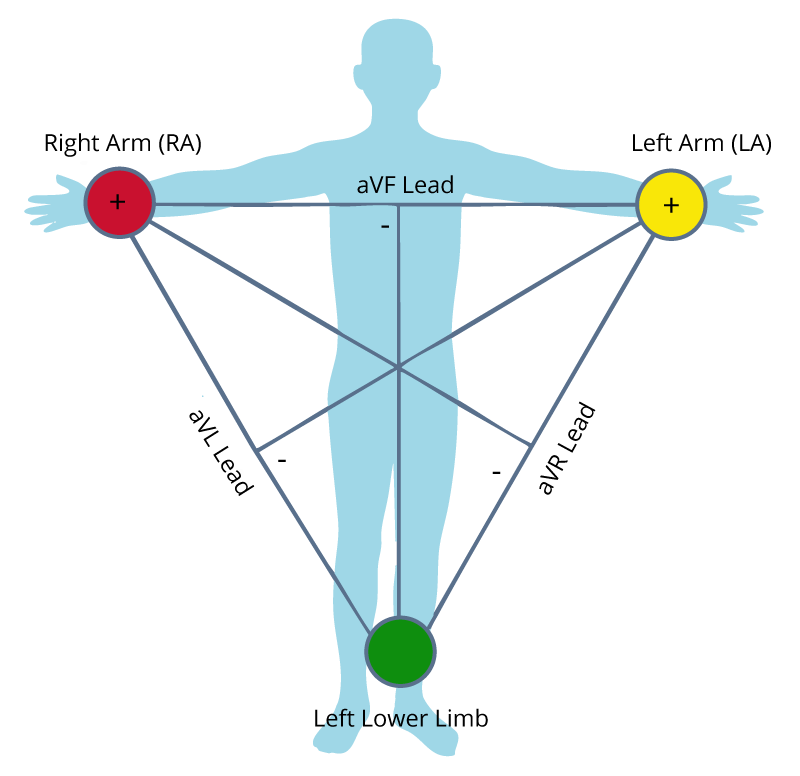
Einthoven’s Triangle
Einthoven’s Triangle is a concept in electrocardiography (ECG) introduced by Dutch physiologist Willem Einthoven, who developed the first practical ECG in the early 20th century. It is a theoretical triangle formed by placing electrodes on the right arm (RA), left arm (LA), and left leg (LL) of a patient. These three points represent the standard limb leads (Lead I, Lead II, and Lead III) in an ECG. With the HP202 6-lead Wearable ECG Monitor the Einthoven’s triangle can be measured.
The triangle helps describe the electrical activity of the heart in two dimensions, with each lead capturing the heart’s electrical signals from a different angle:
- Lead I: Measures the voltage difference between the right arm and left arm.
- Lead II: Measures the voltage difference between the right arm and left leg.
- Lead III: Measures the voltage difference between the left arm and left leg.
Einthoven’s Triangle (for more information see WIKI) provides a foundation for understanding heart rhythms and diagnosing conditions like arrhythmias and ischemia. It paved the way for modern ECG systems by simplifying how electrical signals are recorded.
HP202 P-CARDIO 6-Lead Wearable ECG Monitor key features
Configurable sample rates
The ECG signals can be configured with sample rates of 250, 500, or 1000 sps. The acceleration and gyroscope signals support sample rates ranging from 25 to 800 sps in multiples of 2, while the magnetometer signal can be sampled at either 50 or 100 sps.
High-resolution raw sensor data
The ECG signals are sampled with a 24-bit resolution. The acceleration, gyroscope and magnetometer with a 16-bit resolution.
Long recordings 10+ days
Optimised for continuous long recordings for more than 10 days. Recordings without in between recharge. The P-CARDIO recorder has a memory size of 16GB.
High-speed recording download
After recording, the recorder is placed in the P-CARDIO docking station, which is connected via a USB to a computer or a USB-on-the-go device. The P-CARDIO docking station enables extremely fast download speeds of up to 20 MB per second. Even the longest recordings can be downloaded with minimal waiting times.
Rechargeable, lightweight & small size
The 6-lead Wearable ECG Monitor is a small (50x35x9mm), lightweight (20gr), rechargeable device.
Wireless BLE 5.2 connectivity
Setup, start/stop recordings and live streaming using wireless BLE 5.2. API available for client specific applications.
Multiple electrode & wear options
Resusable solutions, integration in textiles or ease of use dry electrode patch solutions.
Open API interfaces for own applications
Use the P-CARDIO PC application for fast and reliable data collection or create your own applications using the P-CARDIO API and the integration support we offer.
Custom solutions
We create client specific medical and non-medical solutions. according to our client’s specifications. We offer development, certification and production.
CE certified
CE certified. Directly usable in research studies.

Body attachment & electrodes
The P-CARDIO 1-Lead wearable ECG recorder offers a wide range of ECG electrodes and body attachment options to ensure accurate and comfortable monitoring tailored to individual needs. Here’s the various attachment methods that P-CARDIO wearable currently offers.
Standard ECG Electrodes
Wired recorder holder
Shielded wire recorder holder with single standard gel or dry electrodes. The most accessible and straightforward option, ideal for everyday use. Simply attach the wires to the ECG stickers, making it quick and easy to set up. This method ensures reliable data capture and minimal setup complexity, making it a popular choice for users of all experience levels.
Body Attachment
Patch: stick the recorder holder to the body with a disposable patch.

Lanyard: hang the recorder with a lanyard around the neck.

Dry Electrode Health Patches
Integrated dry electrode patches
Self-adhesive dry electrode flexible and breathable TPU patch suited for long wear times for 1L ECG + BioZ Respiration.
Body attachment
Recorder is placed in the disposable recorder holder with integrated dry electrode patch.
Dry electrode patches are offered in combination with partners like TNO/Holst and others.


Textile & Strap Electrodes
ECG snap recorder holders
ECG snap recorder holders for direct snap (4-6, different snap sizes) attachment to straps and textile wearables.
Body attachment
Snap recorder holder is clicked to the strap of textile wearable with integrated sensors.
Extra sensors & custom solutions
The P-CARDIO 6-Lead wearable ECG monitor can be expanded with extra sensors through the digital interface. This makes it possible to easily integrate additional sensors to enhance monitoring capabilities. Currently, we support solutions for the following sensors, however for more details on customising your setup and integrating other sensors, feel free to contact us. See the full list of wearable biosignal sensors and their specifications.
Temperature sensor
Enhance the P-CARDIO platform by incorporating one or more temperature sensors to monitor skin or environmental temperatures. Additionally, integrate temperature sensors into patches.
PPG sensor
Integrate a PPG sensor into the P-CARDIO platform. to measure heart rate and other vital signs. PPG can be used for tracking of cardiovascular health. Utilize the PPG signal to derive the SpO2 oxygenation level, providing a comprehensive assessment of blood oxygen saturation.
GSR sensor
Integrate a galvanic skin response sensor into the P-CARDIO platform to monitor changes in skin conductivity, which can indicate stress levels and emotional states.
Universal strain sensor
Incorporate a universal strain sensor into the P-CARDIO platform to measure mechanical deformation, respiration or movement, enhancing the monitoring of motion and various other vital signs.
Download & Docking Station
The P-CARDIO recorder transfers high-resolution data via the high-speed docking station with speeds upto 20 MB/s. At the same time the docking station also charging the device, ensuring it’s always ready for use. The docking station integrates seamlessly with the P-CARDIO Software Application for quick measurement setup and analysis.
Learn more about connectivity and download options.


Software
The P-Cardio PC software is a comprehensive application designed to seamlessly integrate with P-CARDIO wearable ECG recorders, offering a range of powerful functionalities for users. Key features include:
1. Setup and Recording Management: Easily configure scheduled start and stop times for recordings, ensuring precise data capture tailored to specific needs. Users can also download recordings either via the docking or wirelessly, providing flexibility and convenience in data management.
2. Status Information: Stay informed with real-time device status, battery levels, and recording progress, ensuring uninterrupted monitoring and optimal performance.
3. Live View: Access live views of ECG, respiration, and motion signal traces, enabling immediate assessment of physiological signals.
4. Operating System Compatibility: The software is compatible with Windows 10/11, with an optional version available for MAC OSX, ensuring broad accessibility across different computing environments.
Overall, the P-Cardio PC software is an essential tool for enhancing the functionality of P-CARDIO recorders, providing robust setup options, real-time monitoring, and seamless data management.
Technical Specifications
6-Lead Wearable ECG Monitor
- Sensors: 2 Channel ECG (6 lead) + Motion (acc, gyro, mag)
- ECG:
- Sample rate: 250/500/1k sps,
- Resolution: 24bit with right-leg drive
- Channels: 2
- Acceleration & gyroscope:
- Sample rate: 25, 50, 100, 200, 400, 800hz,
- Resolution 16bit
- Magnetometer:
- Sample rate: 50, 100,
- Resolution: 16bit
- ECG:
- Lead on/off detection: for ECG & respiration
- Event marker button
- Storage capacity: 16GB
- Power: rechargable 400mAHrLiPo battery, recordings up to 10 days
- Indicators: wireless BLE, power, warning
- High-speed recording download: > 20Mbyte per sec
- Wireless BLE 5.2: setup, start/stop, live streaming
- Dimensions [L x H x D]: 50 x 35 x 9mm
- Weight: 20gr
- Waterproof IP67
- Device Application Interface (API): available
- CE certified
Recorder holders & electrodes
- Wired / gel electrodes: Reusable recorder holder for standard gel Ag/AgCl electrodes
- Snap electrodes: Reusable recorder holder with snaps to attach to textile wearables and straps
- Patches: Disposable dry electrode patch for long measurements
- Body attachment: lanyard, textile strap or patch
Docking station
- High speed recording download: (20MByte per second) & measurement setup
- Recharge: recorder charging
Wireless dongle
- Connectivity: Wireless BLE 5.2 communication with API
- Functions: setup, start/stop recording, live streaming, time sync
Software application
- Functions: setup (scheduled start/stop) & download recording (via docking and/or wirelessly)
- Status information: Device, battery and recording status information
- Live view: Live view of ECG, respiration and motion signal traces
- OS: Windows 10/11, MAC OSX optional
Benefit of a 2 Channel ECG as measured with the 6-lead Wearable ECG Monitor
The main benefit of a 2-channel ECG versus a 1-channel ECG lies in the increased amount of information and improved accuracy for heart monitoring. A 1-channel ECG is sufficient for basic heart rate and rhythm analysis and is commonly used in wearables or preliminary monitoring. A 2-channel ECG offers better accuracy, reliability, and diagnostic capabilities due to the additional vector, making it more suitable for advanced monitoring or research. Here’s a detailed comparison:
More Detailed Information
- A 1-channel ECG records electrical activity from a single vector (or direction) of the heart.
- A 2-channel ECG records from two different vectors, providing more comprehensive data about the heart’s electrical activity.
Improved Detection of Abnormalities
- A 1-channel ECG may miss certain types of arrhythmias or subtle electrical abnormalities due to limited perspective.
- A 2-channel ECG increases the chances of detecting anomalies like atrial fibrillation, ischemia, or other subtle rhythm changes.
Better Signal Quality and Redundancy
- With two channels, if one channel suffers from noise or artifacts (e.g., movement or muscle signals), the other channel can still provide clear data.
- This makes 2-channel ECGs more reliable for continuous or ambulatory monitoring.
Enhanced Diagnostic Capability
- 1-channel ECGs are often used for basic heart rate and rhythm monitoring.
- 2-channel ECGs provide additional angles, which are valuable for healthcare professionals to diagnose more complex conditions.
Greater Spatial Coverage
The two leads in a 2-channel ECG record electrical activity from different parts of the heart, offering broader spatial coverage compared to a single lead.
Need more information?
Contact P-CARDIO wearables to find out how we can help each other.

Frequently Asked Questions
What is the advantage of using a 6-lead ECG monitor compared to single or dual-lead systems?
A 6-lead ECG provides multiple perspectives of the heart’s electrical activity, enhancing the ability to detect subtle arrhythmias, ischemia, and other abnormalities compared to single or dual-lead systems. The HP202 can be used to measure the Einthoven’s Triangle.
How long can the 6-lead ECG monitor record data?
The device typically supports long-term recordings, with continuous monitoring for up to 10 days, depending on battery life and sample configuration.
What activity data does the device capture in addition to ECG?
The device includes physical activity and motion sensing via accelerometer, gyroscope, and magnetometer, enabling activity recognition, posture tracking, and movement analysis.
How accurate is the ECG signal in this device?
The device offers high-resolution 24-bit ECG data with configurable sampling rates, ensuring clinical-grade accuracy for detailed analysis.
Is the 6-lead wearable ECG monitor suitable for ambulatory monitoring?
Yes, its compact design and lightweight build make it ideal for ambulatory and long-term heart rhythm monitoring.
Can the device detect arrhythmias such as atrial fibrillation?
Yes, the multi-lead configuration improves detection of arrhythmias like atrial fibrillation, premature contractions, and other complex rhythm disturbances.
Is the device waterproof?
The device features an IP67 rating, making it resistant to water and dust for continuous and outdoor use.
How is the device worn?
The monitor can be attached using adhesive (dry electrode) patches (prototypes available), chest straps, or textile-based wearables to ensure patient comfort and accurate readings.
Is the monitor certified for clinical use?
The device is CE-certified and suitable for clinical research and diagnostic applications, depending on regulatory requirements.
What types of patients benefit most from this device?
The 6-lead wearable monitor is ideal for patients requiring post-operative monitoring, arrhythmia screening, long-term ECG studies, or activity correlation with heart rhythms.
What communication protocols does the device support?
The monitor supports wireless BLE 5.x for real-time data streaming and configuration, and it can connect to mobile and desktop platforms via the docking station using a USB interface for downloading recordings.
Is there an open API for software integration?
Yes, the device comes with an open API, enabling seamless integration with custom software solutions for data analysis, cloud uploads, and third-party applications.
How is data stored and transferred?
The device supports on-board memory storage (16GB) for extended recordings, with fast data transfers via docking stations at speeds up to 20 MB/s.
Can the ECG data be streamed in real time?
Yes, real-time ECG streaming is supported via Bluetooth for live monitoring or integration with compatible applications.
What sampling rates are available for ECG and activity data?
The ECG sampling rate is configurable between 250-1000 sps, and motion sensor data can be sampled at rates between 25-100 Hz (higher on request), providing flexibility for advanced signal processing.
